

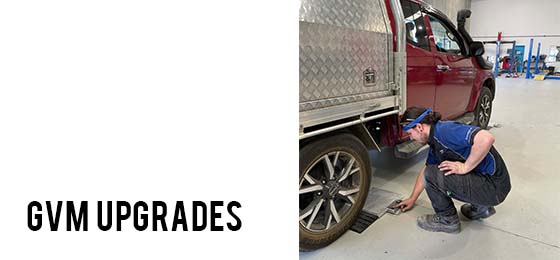


WHITELINE, MCA, POLYAIR, RIVAL Leaf Springs
A leaf spring is a stack of curved steel plates that carries the vehicle's weight and holds the axle in position at the same time. That dual job is what separates it fr...
Read moreA leaf spring is a stack of curved steel plates that carries the vehicle's weight and holds the axle in position at the same time.
That dual job is what separates it from a coil. A coil only springs, so the axle needs arms and a panhard rod to locate it. A leaf spring does both, which is why it persists on utes, trucks, trailers and anything built to carry weight.
What a Leaf Spring Does and How It Works
The pack is held together by a centre bolt through the middle, with clips along its length keeping the leaves aligned side to side. The longest leaf, the main leaf, has an eye formed at each end.
The front eye bolts solid to a hanger on the chassis. The rear eye attaches to a shackle, a short swinging link that lets the spring lengthen as it flattens out under load. Without that shackle the spring could not flex, since an arc straightening out gets longer.
As the suspension compresses, the leaves slide against each other. That inter-leaf friction damps the movement and resists rebound, which is why leaf sprung vehicles were usable before shock absorbers became common. It also makes the ride firmer than a coil, since the spring resists small movements before it begins to flex at all.
Because the spring locates the axle as well as springing it, a soft leaf spring is not an option. The stiffness that holds the axle in place under braking and acceleration is the same stiffness you feel over bumps.
Leaf Spring Types: Eye and Eye, Slipper, Rocker Roller and Parabolic
Four arrangements cover most applications and they are not interchangeable.
Eye and eye is the traditional automotive leaf spring, with a formed eye at both ends, one fixed and one on a shackle. It is the most common arrangement on vehicles and on multi-axle trailers.
Eye and slipper has an eye at the front and a flat, open end at the rear that slides against a wear pad rather than pivoting on a shackle. Common on single axle trailers, simpler and cheaper, with less control over the axle.
Rocker roller suspension links the springs of a tandem axle setup through a rocker assembly, so when one axle takes more weight than the other, load transfers between them. That matters crossing gutters and rough ground, where a tandem trailer would otherwise lift a wheel.
Parabolic leaf springs taper each leaf so the leaves touch only at the ends and the centre rather than along their whole length. That removes most of the inter-leaf friction, giving a ride considerably closer to a coil spring, at the cost of some load capacity and a greater reliance on the shock absorbers to do the damping the friction used to.
Which arrangement suits depends on the vehicle, and on a trailer, on whether it runs a single or tandem axle.
How Leaf Springs Are Made and Why Quality Varies
Multi-leaf springs are formed from spring steel, cut and tapered to length, with the eyes rolled into the main leaf, then hardened and tempered.
Tempering is the step that decides how tough the finished spring is. The leaves are heated below their recrystallisation temperature and cooled in a controlled way, with hardness verified afterwards. Get it wrong and the spring either cracks or sags early.
Beyond the heat treatment, the features that separate a good spring from a cheap one are mostly about friction and noise. Shot peening the main leaf improves fatigue life. Graphite coating and anti-friction slipper pads between the leaves reduce the stiction that makes a leaf sprung vehicle feel harsh over small bumps. Tapered and diamond cut leaf ends do the same.
Bolt clips and clip liners keep the pack aligned and quiet. A military wrap, where the main leaf wraps fully around the second leaf at the eye, prevents the pack separating if the main leaf fails.
Springs made and tested in Australia are built around the loads and surfaces local vehicles actually see.
Leaf Spring Constant Load Ratings Explained
Australian leaf springs are specified by constant load rather than just by lift, and this is the number that decides whether you get what you paid for.
A 300kg constant load spring is designed to sit at its nominated height while carrying 300kg permanently. A 500kg spring does the same at 500kg. Ratings run from around 50kg through to 800kg depending on the application, with lift heights typically from 20mm to 80mm.
The rating refers to what you are adding, not the weight of the vehicle. A ute with a tray, canopy, drawers, a water tank and tools sits in a different band to the same ute running empty.
Choose too low and the spring flattens under your actual load and sits lower than standard. Choose too high and the vehicle rides harshly and sits tail up when the tray is empty, because the spring never sees the weight it was wound for.
Weigh the permanent load if you can rather than estimating it. People consistently guess low on what a fitted-out vehicle actually carries.
Leaf Springs for 4x4 and Commercial Vehicles
Leaf springs suit load carrying for a reason, which is that they spread weight across a length of chassis rather than concentrating it at a single mounting point like a coil does.
For a trade vehicle, a touring 4WD or anything running a permanent tray, that distribution matters as much as the spring rate, which is why 4x4 leaf springs are rated around load rather than lift alone.
The trade-off on a factory setup is ride quality. Manufacturers often run a soft first stage and a much stiffer second stage, so an unladen vehicle rides on the soft stage and then hits the second with a jolt. A firmer, better matched first stage removes that step and gives a smoother ride loaded or empty.
Articulation is the other consideration on a 4x4. A leaf sprung rear end offers good travel and will tolerate abuse that a more complex arrangement will not, which is why it remains standard on serious off road vehicles.
Trailer, Caravan and Boat Trailer Leaf Springs
Trailers use leaf springs almost universally, and the requirements differ from a vehicle.
Box trailers and utility trailers typically run a single axle with eye and slipper springs, where simplicity and cost matter more than ride.
Caravans and camper trailers often run tandem axles, where eye and eye springs with a rocker roller arrangement share load between the axles and keep both on the ground over rough ground.
Boat trailers face a problem the others do not, which is salt water. A boat trailer spring is submerged regularly and corrodes from the inside of the pack outwards, so corrosion resistance matters more than anything else on this application and springs should be inspected far more often than their road use suggests.
Trailer springs are rated by the load per axle, and overloading is the most common cause of premature failure.
Adding a Leaf, Replacing the Pack or Fitting Helper Springs
Three routes exist when a vehicle needs more capacity, and they are not equivalent.
Adding a leaf to the existing pack is the cheapest. It raises the vehicle slightly and adds some capacity, and the trade-off is a stiffer ride, since you have added spring without redesigning the pack.
Replacing the pack entirely with heavy duty leaf springs or a correctly rated set is the proper fix. It gives you the capacity, the ride height and the travel designed together, rather than a factory pack with something extra wedged into it.
Helper springs and airbags work alongside the existing pack, adding support only when the load goes on. Those suit a vehicle that is empty most of the time and loaded occasionally.
Lift blocks between the spring and the axle raise the vehicle without changing the spring at all, which solves height and does nothing for capacity. Longer U-bolts are required, and blocks beyond a modest height introduce axle wrap under acceleration.
Signs Your Leaf Springs Need Replacing
- The vehicle sitting lower than it should, particularly at the rear
- One side sitting lower than the other
- The spring pack looking flat, or arching backwards rather than upwards
- Bottoming out on the bump stops over bumps the vehicle used to absorb
- Squeaking or groaning from the rear over bumps, which is dry or worn inter-leaf contact
- A cracked or broken leaf, visible as a gap or a dropped end
- Leaves that have spread apart or shifted out of alignment
- Heavy corrosion or flaking rust between the leaves
- Worn shackles, bushes or hangers with visible play
- Axle tramp or hopping under hard acceleration
If you are wondering how leaf springs should look, a flattened pack is the most common fault and the most ignored. Rear leaf springs are supposed to arc upwards, and a spring that has gone flat has lost most of its travel even if nothing has broken.
Shackle Angle and Why Lifting Changes Your Leaf Springs
Worth understanding before fitting lift springs, because it is the detail that separates a good leaf spring upgrade from a poor one.
The shackle angle determines how the spring behaves as it flexes. Raising a vehicle changes the camber of the spring and the angle of the main leaf, which changes where the shackle sits and how the suspension moves through its travel.
A spring designed with a lengthened main leaf keeps the shackle at a sensible angle at the new ride height, rather than leaving it standing nearly vertical where it provides little of the movement the spring needs.
That is also why lift blocks and add-a-leafs behave differently to a properly designed lift spring. They raise the vehicle without addressing the geometry that the extra height has changed.
Replacing U-Bolts and Bushes When Leaf Springs Go In
Leaf spring work involves heavy components under load, and U-bolts holding the axle to the spring that are single use by design once stretched.
Replace the U-bolts whenever the pack comes off. They are torqued into their yield range and reusing them is not worth the risk.
Replace the spring eye bushes and the shackle bushes at the same time, since both wear on the same timeline and the access is already paid for.
Check the hangers and shackle plates for elongation and corrosion while everything is apart, because a new spring bolted into a worn hanger will not sit or behave correctly.
Torque the U-bolts evenly and in sequence, then retorque them after the first few hundred kilometres once the pack has settled.
Fulcrum has been working on suspension since 1976, across 16 Service Centres and 200+ authorised workshops nationwide, and leaf spring work is a core part of what the network does.
Find Leaf Springs for Your Vehicle
Parabolic setups are available in parabolic leaf spring kits, and fixed pins and leaf spring accessories cover the hardware around the pack. Coil sprung vehicles are covered in the full suspension springs range.
Select your vehicle to see the leaf springs and leaf spring kits available for it, in standard, heavy duty and raised specifications. Check the constant load rating each one is designed around before ordering. Warranty and a fitment guarantee come with everything we sell, supported by workshops in every state.
- $329.00Fully installed for $759.00within 2 weekspreorderAvailable for Preorder. Stock due on 23/11/2026.
- $281.00Fully installed for $711.00within 2 weekspreorderAvailable for Preorder. Stock due on 23/11/2026.
- $329.00Fully installed for $759.00within 2 weekspreorderAvailable for Preorder. Stock due on 23/11/2026.
- $317.00Fully installed for $747.00within 2 weekspreorderAvailable for Preorder. Stock due on 23/11/2026.
- $329.00Fully installed for $759.00within 2 weekspreorderAvailable for Preorder. Stock due on 23/11/2026.
- $343.00Fully installed for $773.00within 2 weekspreorderAvailable for Preorder. Stock due on 23/11/2026.
- $329.00Fully installed for $759.00within 2 weeksin stockShips within 3 business days.
- $328.00Fully installed for $1,043.00within 2 weekspreorderAvailable for Preorder. Stock due on 23/11/2026.
- $395.00Fully installed for $825.00within 2 weekspreorderAvailable for Preorder. Stock due on 23/11/2026.
- $329.00Fully installed for $759.00within 2 weeksin stockShips within 3 business days.
- $166.00Fully installed for $691.00within 2 weekspreorderAvailable for Preorder. Stock due on 23/11/2026.
- $166.00Fully installed for $691.00within 2 weekspreorderAvailable for Preorder. Stock due on 23/11/2026.
- $166.00Fully installed for $691.00within 2 weekspreorderAvailable for Preorder. Stock due on 23/11/2026.
- $166.00Fully installed for $691.00within 2 weekspreorderAvailable for Preorder. Stock due on 23/11/2026.
- $219.00Fully installed for $744.00within 2 weekspreorderAvailable for Preorder. Stock due on 23/11/2026.


